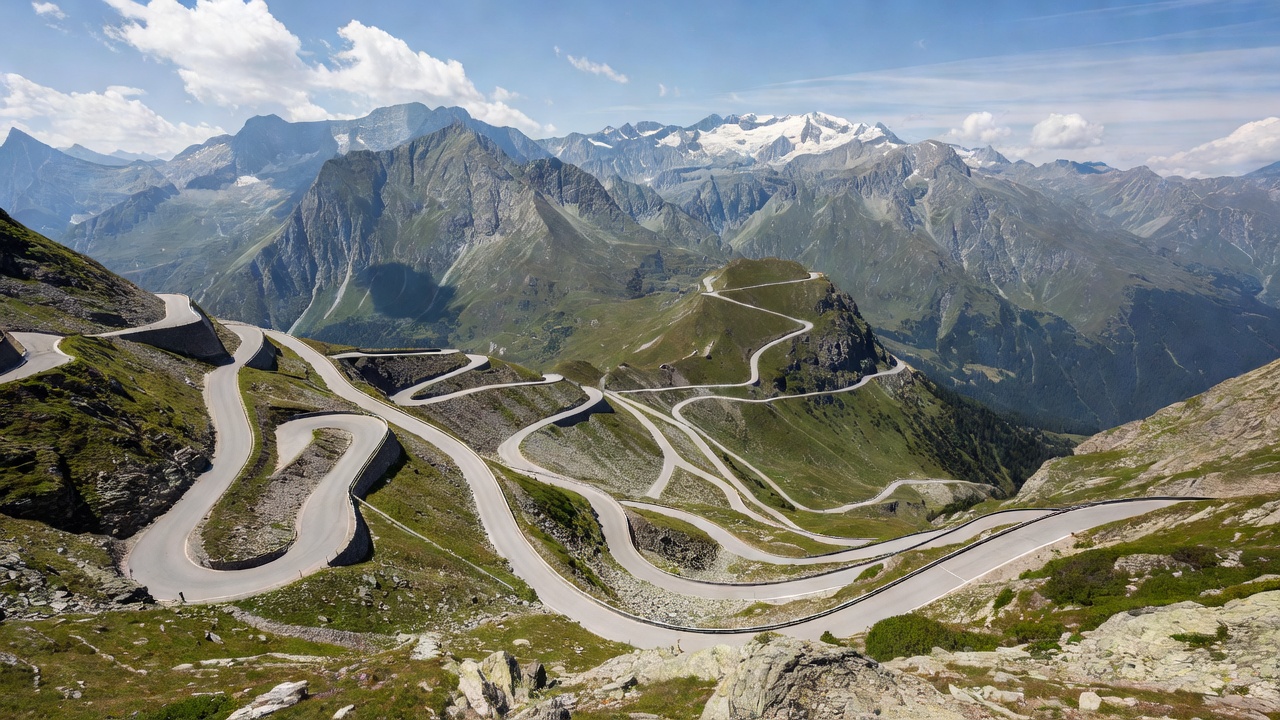
If there is a geographic epicenter for alpine driving perfection, it resides near the town of Andermatt in central Switzerland. From this central hub, three massive mountain passes connect to form a continuous 120-kilometer loop: the Susten, the Grimsel, and the Furka passes. Because they link together so cleanly, a driver can tackle all three in a single day, experiencing a dense concentration of highly engineered switchbacks, deep granite valleys, and imposing reservoirs.
Swiss road engineering is famously precise, and these passes reflect that national trait. The road surfaces are largely immaculate, stone retaining walls are built to last centuries, and the layout often prioritizes a steady, drivable rhythm over chaotic, jagged hairpins. Driving this loop is an exercise in appreciating monumental infrastructure grafted onto a hostile natural environment.
Susten, Grimsel, and Furka
The Susten Pass (2,260m) is generally regarded as the driver's favorite of the three. Built primarily in the 1930s and 40s specifically for motorized traffic, its curves are sweeping, the straights allow for safe overtaking, and the sightlines are excellent. The eastern ascent from Wassen cuts through thick forests before opening into a barren, rocky amphitheater beneath the Stein Glacier. It is wide, fast, and rhythmic.
The Grimsel Pass (2,164m) offers a stark visual contrast. Characterized by deep, dark granite and a series of massive hydroelectric dams, the landscape feels industrial and moody. The road wraps around the edges of high-altitude reservoirs. The southern descent features complex, stacked hairpins that look like concrete ribbons draped over the cliff face, dropping heavily into Gletsch.
From Gletsch, the Furka Pass (2,429m) begins immediately. Famous as the backdrop for the Aston Martin DB5 chase sequence in the James Bond film Goldfinger, the Furka is narrower and more intimidating than the Susten. The drops are sheer, often protected by only modest concrete bollards. Near the summit, the Hotel Belvédère sits precipitously on a hairpin overlooking the Rhone Glacier—one of the most photographed corners in the entire alpine network.
Pros and Cons
The principal advantage of this loop is efficiency. Nowhere else in Europe can you cross three major 2,000-meter passes in such rapid succession without backtracking. The roads are free of tolls (though a Swiss motorway vignette is required if using highways to reach the area), and the proximity of the passes makes logistics remarkably simple.
The primary drawback is the severe Swiss enforcement of traffic laws. Speed limits (typically 80 km/h outside of villages) are strictly enforced by police patrols and mobile speed cameras. Fines in Switzerland are famously punitive, scaling with income, and severe infractions can lead to vehicle confiscation. Consequently, this loop must be driven with restraint; it is about finding a smooth flow through corners rather than chasing top speed on the straights.
Logistics
Andermatt or Innertkirchen serve as the best starting points. Clockwise or counter-clockwise directions are equally rewarding, though many prefer driving the Furka from west to east to position the car on the outside edge of the cliff for unobstructed views of the Rhone Valley. Due to extreme snowfall, these passes are firmly closed in winter. The Susten is often the last to open in the region, sometimes remaining barred until late June. To avoid heavy motorcycle traffic and tourist buses, depart your hotel before 6:30 AM.