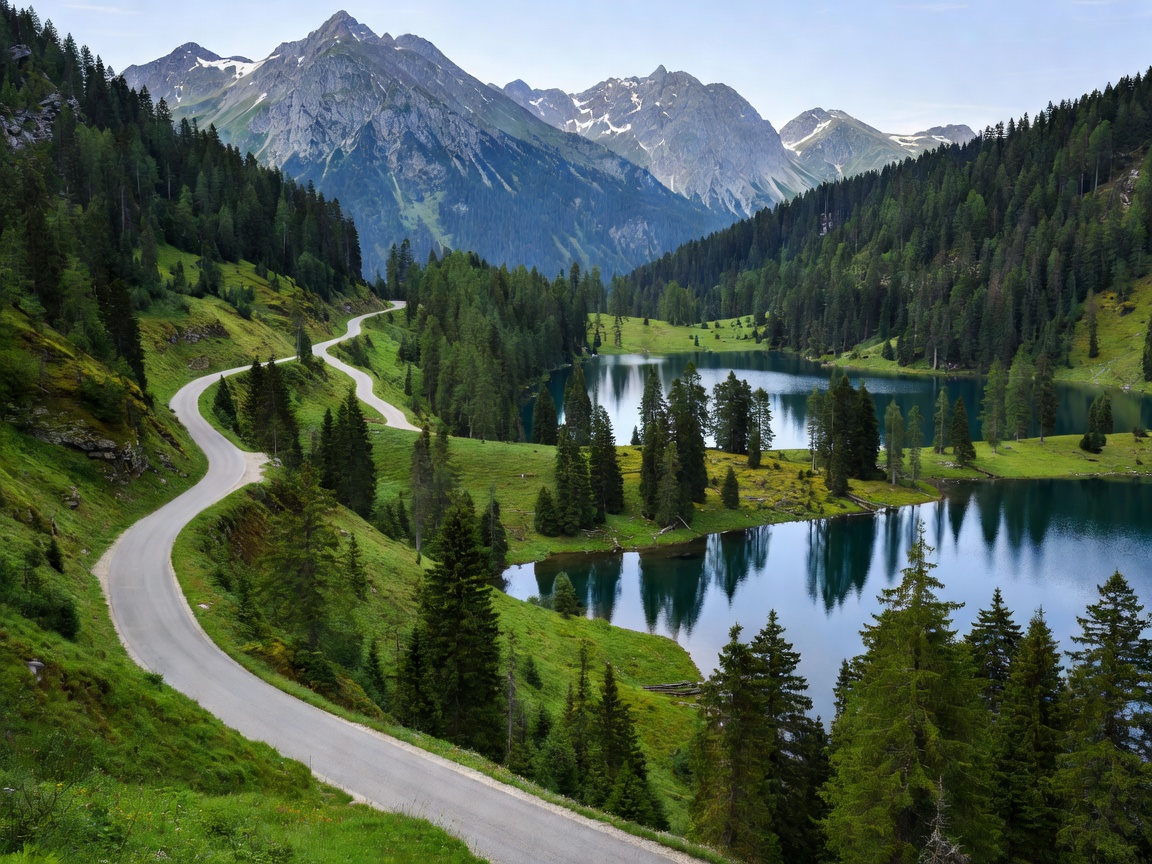
The German Alpine Road (Deutsche Alpenstraße) is the oldest touring road in Germany. Unlike the high-altitude pass routes of Switzerland and France that aim to conquer the highest summits, the Bavarian route traces a 450-kilometer path through the gentle, rolling foothills just north of the Austrian border. Stretching from the island town of Lindau on Lake Constance in the west to Schönau am Königssee in the east, the route prioritizes cultural density and pristine lakeside cruising over terrifying elevation changes.
Because the road largely avoids crossing over 1,200 meters in elevation, it lacks the aggressive hairpin stacks required in the high Alps. Instead, the driving profile consists of long, sweeping curves through dense fir forests, open meadows dotted with traditional Bavarian farmhouses, and causeways alongside expansive lakes.
The Cruising Experience
Driving the German Alpine Road is an exercise in grand touring rather than limit-handling. The road surfaces meet the exceptional standards expected of German infrastructure—smooth, well-cambered, and perfectly signposted. Highlights include the stretch passing through the Allgäu region, where the road meanders gracefully around the Großer Alpsee, and the approach to Füssen, which reveals sudden, dramatic views of Neuschwanstein Castle.
Further east, the route carves past the Zugspitze—Germany's highest mountain—and drops into the picturesque lake districts of Tegernsee and Schliersee. Here, the driving rhythm frequently slows to accommodate village traffic. A low, burbling exhaust note is best enjoyed here, reflecting off the wooden chalets as you cruise at a measured pace. The final leg plunges into the Berchtesgaden National Park, offering the most dramatic mountain scenery of the entire route before terminating at the emerald waters of Königssee.
Pros and Cons
The primary advantage of the German Alpine Road is its accessibility. Because it remains at lower elevations, it is open year-round, transforming into a magical, snow-banked winter drive (provided proper winter tires are fitted). The cultural infrastructure is unmatched: drivers are never more than a few kilometers from a world-class inn, historic abbey, or a traditional beer garden.
The disadvantage lies in its popularity and lack of extreme technical challenge. Thrill-seekers looking for the white-knuckle drops of the Stelvio or the Furka will find the Bavarian route too tame. Additionally, because it links several major domestic tourist hubs, weekend traffic can be dense. Traffic jams around Garmisch-Partenkirchen and Tegernsee on a sunny Sunday afternoon are a near certainty.
Logistics
To properly experience the 450 kilometers, plan for three to four days. This pacing allows for necessary cultural detours, such as exploring the Linderhof Palace or taking the cable car up the Zugspitze. Navigation is entirely straightforward; the route is well-marked with distinct brown and white signs bearing the Edelweiss logo. For international travelers, flying into Munich provides an ideal starting point, putting you within an hour's drive of the route's mid-point.