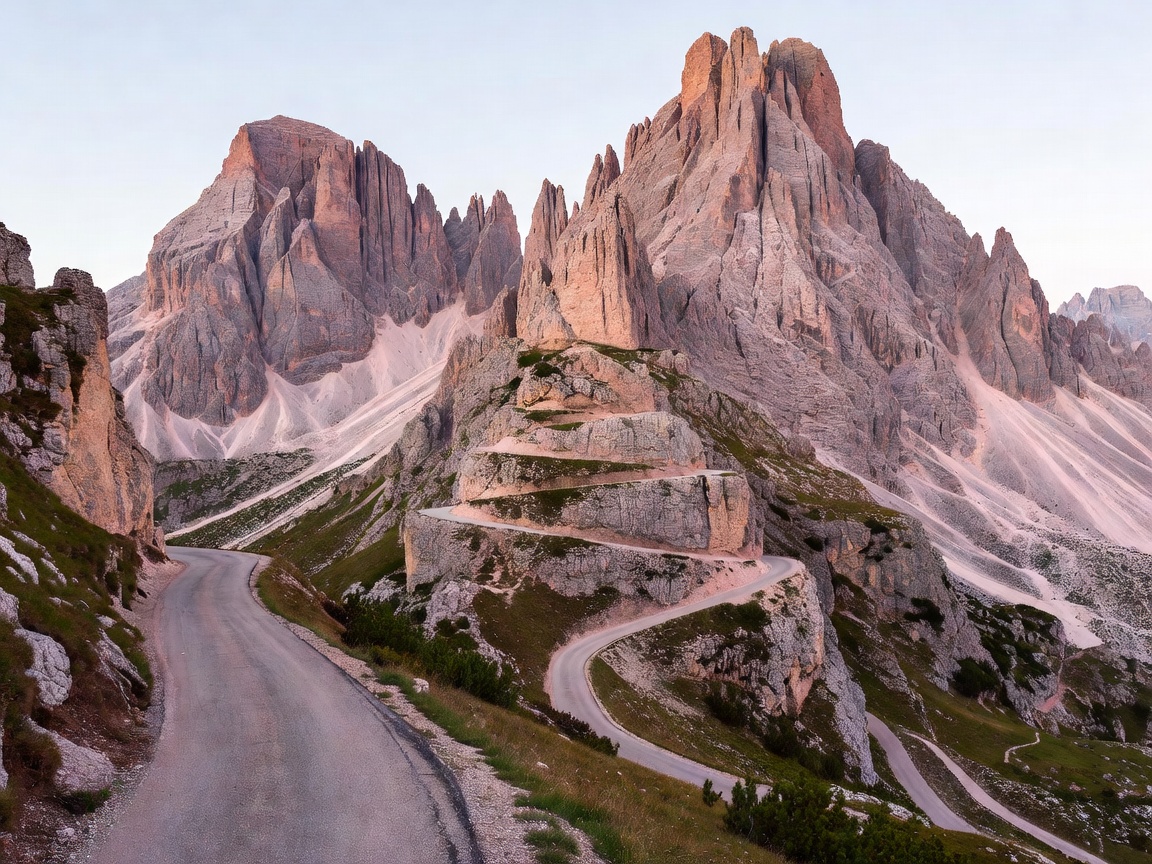
The Grande Strada delle Dolomiti, or Great Dolomites Road (primarily Route SS48), charts a 110-kilometer course between Bolzano and Cortina d'Ampezzo. While it lacks the extreme altitudes of the French Alps or the wide-radius sweepers of the Swiss passes, it compensates with an unparalleled visual spectacle. The Dolomites are composed of pale limestone and dolomite rock, creating vertical, jagged spires that glow pink and orange during sunrise and sunset—a phenomenon known locally as enrosadira.
Completed in 1909 under the Austro-Hungarian Empire to facilitate transport across the rugged terrain, the road serves as a vital artery through South Tyrol and Veneto. The driving experience here is distinctly Italian: roads are narrower, traffic flows faster than foreigners might expect, and right-of-way on single-lane pinch points is negotiated rapidly.
Navigating the Falzarego and Pordoi
Heading west from the chic ski town of Cortina d'Ampezzo, the route immediately tackles the Passo Falzarego (2,105m). The road ascends through thick pine forests before breaking into a rugged basin below the towering Lagazuoi mountain. The ascent features a dense cluster of hairpins that demand first gear in anything but a highly torquey vehicle. The surface is occasionally broken by frost heaves, making stiffly sprung sports cars nervous on corner entry.
Further along lies the Passo Pordoi (2,239m), the highest paved pass on the historic route. With 28 hairpins on the eastern ramp and 33 on the western descent into the Val di Fassa, the Pordoi is a relentless steering exercise. The layout is tight, and drivers must constantly monitor oncoming traffic. Tourist buses frequently cross the center line to swing their rear axles through the corners, forcing ascending traffic to yield completely.
Pros and Cons
Aesthetically, the Great Dolomites Road is without peer. The proximity to the vertical rock faces makes the mountains feel intensely close, rather than distant backdrops. Furthermore, the region’s unique Tyrolean culture offers excellent culinary and hospitality options; stopping for an espresso or a plate of speck dumplings at a mid-pass rifugio is an essential part of the rhythm.
The main negative is spatial constraint. The SS48 is a major functional artery, not just a tourist drive. You will encounter local delivery vans, public transit buses, and heavy commercial traffic. The road is often narrow, with minimal margins for error, and overtaking opportunities are rare. In August, the volume of motorhomes can reduce average speeds to a crawl. Drivers looking for uninterrupted, high-speed sweeping corners will be frustrated.
Logistics
To capture the enrosadira light and beat the coaches, a pre-dawn departure from Cortina is highly recommended. The entire length from Cortina to Bolzano can be driven in roughly three to four hours without stops, but budgeting six hours allows time for the cable car ride at Passo Pordoi or a detour to the neighboring Passo Sella. Unlike the high Swiss passes, sections of the SS48 are kept open in winter for ski resort access, though proper winter tires and chains are strictly mandatory.