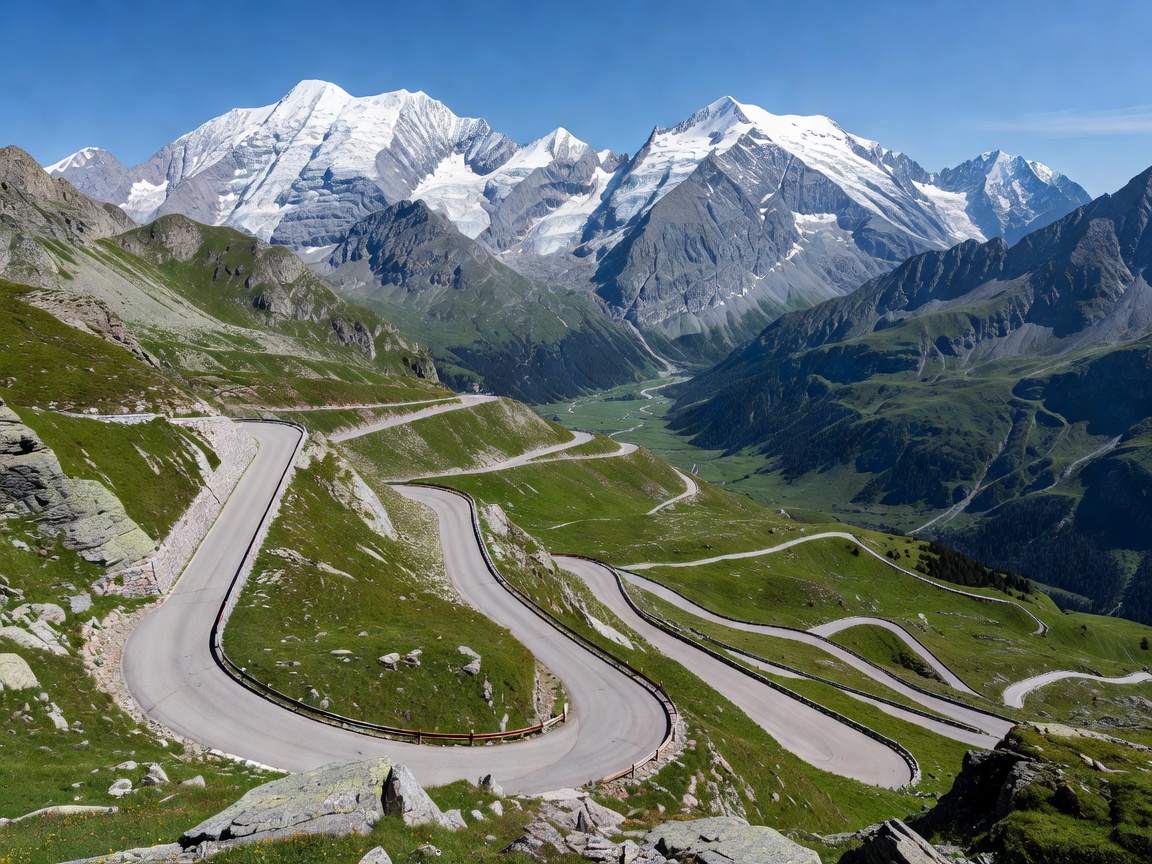
The Grossglockner High Alpine Road (Grossglockner Hochalpenstraße) is not merely a method of crossing the Hohe Tauern mountain range; it is an institution of European motoring. Constructed in the early 1930s, primarily as an employment project and a testament to Austrian engineering, the road was expressly designed to maximize scenic value. Consequently, it represents one of the few instances in the Alps where a mountain pass was built primarily for tourism rather than strict geographic utility.
Connecting the state of Salzburg to Carinthia, the 48-kilometer toll road delivers 36 sweeping hairpin bends, climbing to an altitude of 2,504 meters at the Hochtor Pass. The environment transitions rapidly from lush, forested valleys to stark, high-alpine tundra, culminating at the Kaiser-Franz-Josefs-Höhe visitor center. From here, drivers look out directly onto the Pasterze Glacier and Austria's highest peak, the Grossglockner (3,798m).
Driving Dynamics
Unlike tighter, older Italian passes, the Grossglockner boasts generous road widths and immaculately maintained tarmac. The radius of the hairpins is generally wide enough to accommodate larger vehicles without the need for multi-point turns, making this an ideal route for GT cars and enthusiastic drivers. However, this accessibility is a double-edged sword: the quality of the road attracts significant traffic. In the peak summer months of July and August, the route sees thousands of motorcycles, camper vans, and bicycles daily.
To experience the road at its best, timing is critical. Entering the toll booths at Fusch (north side) or Heiligenblut (south side) precisely at the opening hour—typically 5:00 AM or 5:30 AM in mid-summer—grants you uninterrupted ribbons of asphalt illuminated by the rising sun. By 10:00 AM, the road often becomes a slow-moving procession, forcing a transition from spirited driving to patient sightseeing.
Key Highlights & Diversions
While the main thoroughfare is spectacular, two dead-end offshoots are mandatory additions to the itinerary. The first is the Edelweissspitze, accessed via a narrow, cobbled detour branching off the northern ascent. Climbing to 2,571 meters, it is the highest accessible point by car on the route. The 360-degree panorama encompasses over thirty peaks exceeding 3,000 meters. The cobbled surface reduces traction, demanding smooth pedal inputs, particularly in wet conditions or when temperatures approach freezing.
The second essential detour is the road leading to the Kaiser-Franz-Josefs-Höhe. Here, the infrastructure shifts heavily toward mass tourism, featuring multi-story car parks and expansive visitor facilities. While busy, standing face-to-face with the retreating ice of the Pasterze Glacier while alpine marmots forage nearby remains a profound experience. The contrast between heavy automotive engineering and raw glacial environment is stark.
Pros and Cons
The primary advantage of the Grossglockner is its exceptional surface quality and sheer dramatic scale. It is widely considered one of the safest high-alpine driving environments due to substantial crash barriers and constant maintenance. The roadside facilities are frequent and well-equipped with restaurants and historical exhibits documenting the road's construction.
The disadvantages center entirely on cost and congestion. The day toll for a passenger car represents a significant investment for a single stretch of road. Furthermore, the commercial success of the road means solitude is nearly impossible to find outside of the extreme fringes of the day or the very beginning and end of the season. Late October drives are particularly risky; heavy snowfall can prompt sudden closures, sometimes trapping drivers who ignore meteorological warnings.
Logistics
Toll tickets are purchased at the physical gates in Fusch or Heiligenblut, or online in advance to bypass queues. The ticket is valid for a single day, allowing multiple entries and exits within operating hours. Drivers planning to explore both the Edelweissspitze and the glacier overlook should budget a minimum of four hours, though a full day is easily spent if visiting the various exhibitions and hiking paths.